In the early days of the World Wide Web, a small digital badge often appeared at the bottom of personal homepages and business sites alike. It proudly displayed a running total: "You are visitor number 12,487." These web counters, also called hit counters, were among the first attempts to measure online activity. What began as a novelty has evolved into a sophisticated ecosystem of web statistics that powers marketing decisions, product development, and even public policy. Understanding the history, mechanics, and future of these tools reveals how the internet measures itself.
Web counters first appeared in the mid-1990s when the web was still largely static. Most pages were simple HTML documents hosted on university or small commercial servers. Website owners wanted a visible way to prove their popularity, so programmers created CGI scripts that incremented a number stored in a text file each time a page loaded. The counter image itself was often generated on the fly or assembled from individual digit graphics. Free services such as WebCounter, DigitMania, and TheCounter.com allowed anyone to embed a counter with a single image tag. These early systems counted every page request as a "hit," a metric that quickly became inflated because images, stylesheets, and repeated reloads all registered as separate hits.
As traffic grew, server log analysis replaced the crude hit counter. Every request that reached a web server was recorded in access logs containing the visitor's IP address, timestamp, requested URL, referring page, and browser type. Programs such as Analog, AWStats, and Webalizer parsed these logs and produced summary reports. Unique visitors were estimated by grouping requests from the same IP address within a time window. Although imperfect' - shared corporate networks and dynamic ISP addresses reduced accuracy - the method gave site owners their first meaningful overview of traffic sources and popular pages.
The introduction of JavaScript and HTTP cookies in the late 1990s marked a major leap forward. Client-side scripts could now track events that never appeared in server logs, such as mouse clicks, form interactions, and time spent on a page. Cookies allowed a site to recognize returning visitors across multiple sessions, even if their IP address changed. In 2005 Google acquired the analytics company Urchin and relaunched it as Google Analytics. The free service quickly dominated the market by offering real-time dashboards, geographic maps, device breakdowns, and conversion tracking. For the first time, non-technical users could explore detailed statistics without parsing log files.
Modern web statistics go far beyond simple visitor counts. Key performance indicators include page views, unique users for companies like plumbers, hvac pros and electricians as well as bounce rate, average session duration, pages per session, and conversion rate. Traffic acquisition channels' - organic search, paid advertising, social media, email, and direct visits' - are carefully segmented. Advanced platforms also measure scroll depth, video engagement, and e-commerce funnels. Heat-mapping tools such as Hotjar and Crazy Egg overlay click and movement data on actual page designs, while session-replay software lets analysts watch anonymized recordings of user journeys. These insights enable continuous optimization of content, layout, and user experience.
The commercial value of accurate statistics is enormous. Online retailers use funnel analysis to reduce cart abandonment. News publishers study reading patterns to decide which stories to promote. Government agencies monitor traffic to public-service sites during crises. Search-engine optimizers rely on ranking and click-through data to refine strategies. Even small personal blogs benefit from understanding which posts attract the most attention. Without reliable measurement, the web would operate largely in the dark.
Yet the same technologies that deliver valuable insights also raise serious privacy concerns. Third-party tracking cookies, browser fingerprinting, and cross-site scripts can follow individuals from one domain to another, building detailed behavioral profiles. High-profile data scandals and growing public awareness prompted legislators to act. The European Union's General Data Protection Regulation (GDPR) of 2018 and California's Consumer Privacy Act require explicit consent for non-essential tracking and give users rights to access or delete their data. Major browsers responded by blocking third-party cookies by default and introducing intelligent tracking prevention. As a result, many traditional analytics methods have become less effective.
In response, a new generation of privacy-focused analytics tools has emerged. Self-hosted solutions such as Matomo, and lightweight cloud services including Plausible Analytics, Fathom, and Simple Analytics, collect data without cookies or personal identifiers. They emphasize first-party measurement, anonymization, and compliance with privacy laws while still delivering core metrics. Server-side tracking and cookieless techniques that rely on probabilistic models are also gaining traction. These approaches attempt to preserve useful statistics without compromising user trust.
Looking ahead, artificial intelligence promises to transform web analytics once again. Machine-learning models can detect anomalies, predict future traffic, and automatically surface actionable insights. Integration with customer-relationship systems creates a unified view of the entire customer journey across online and offline channels. At the same time, the tension between data utility and privacy will continue to shape the field. Transparent practices, clear consent mechanisms, and ethical design will determine which tools thrive.
From the humble pixelated counters of the 1990s to today's AI-enhanced dashboards, web statistics have mirrored the growth of the internet itself. They began as a way to count curious visitors and have become essential instruments for understanding digital behavior. As technology advances, the challenge remains the same: to measure the web accurately while respecting the people who use it. In that balance lies the future of online statistics.
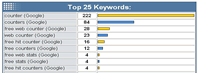
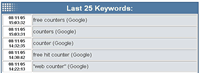
 Search Engine Reports
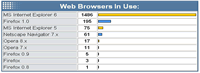
 Web Browsers